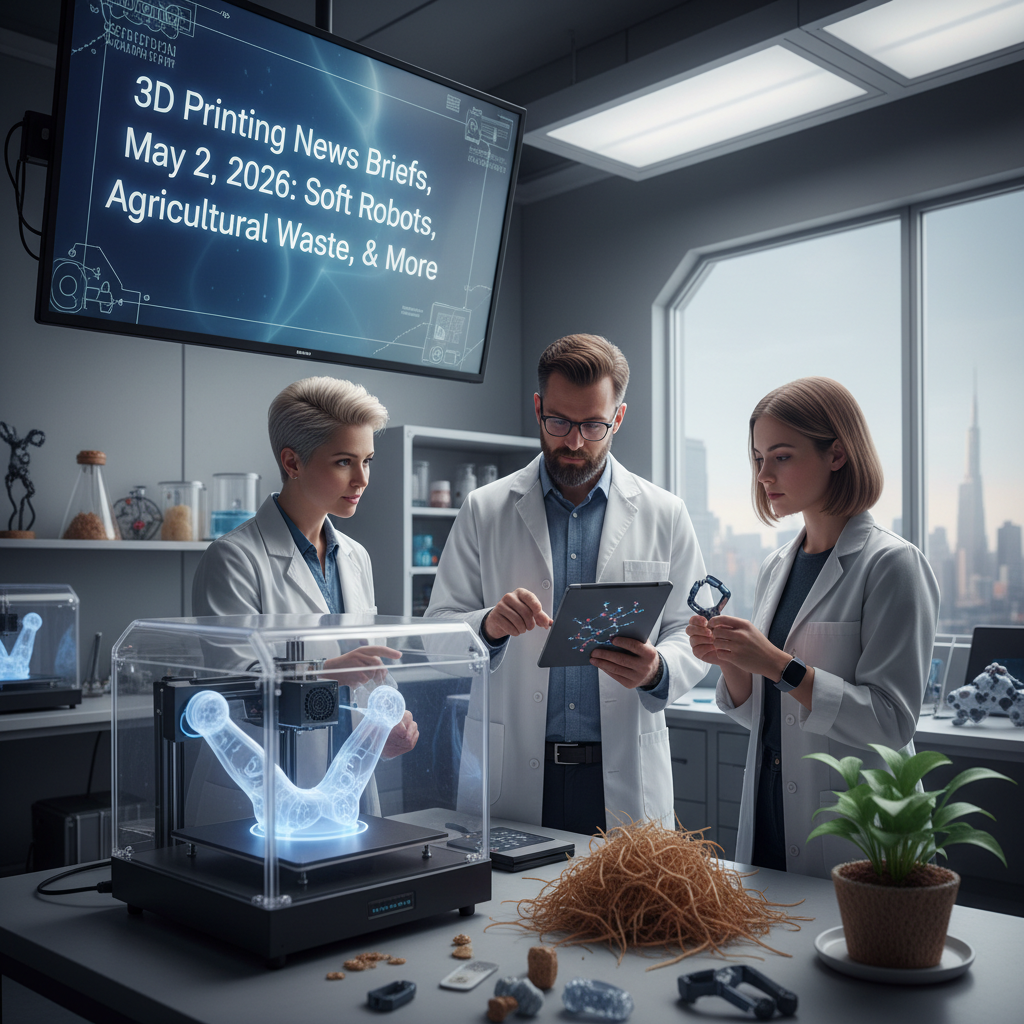
3DPrint.com's latest news briefs from May 2, 2026, offer a comprehensive look at the cutting edge of additive manufacturing. This update highlights significant strides across various sectors, including the deployment of a new multi-laser metal powder bed fusion 3D printer, crucial advancements in post-processing, groundbreaking research in soft robotics, and innovative applications utilizing agricultural waste in additive manufacturing. These developments underscore the industry's continuous evolution towards greater efficiency, sustainability, and technological capability.
Multi-Laser Metal Powder Bed Fusion 3D Printer
The introduction of a new multi-laser metal powder bed fusion (PBF) 3D printer marks a significant leap in metal additive manufacturing. By employing multiple lasers simultaneously, this technology dramatically increases build speeds and allows for larger part production with enhanced geometric complexity. This innovation is poised to revolutionize industries such as aerospace, medical device manufacturing, and automotive, where high-performance metal components are critical. The parallel processing capability not only boosts productivity but also often leads to more consistent material properties across the printed part, reducing manufacturing bottlenecks and expanding the possibilities for complex metal designs.
Post-Processing Advancements
Post-processing has historically been a time-consuming and labor-intensive bottleneck in the 3D printing workflow. Recent advancements are tackling this challenge head-on, with new technologies streamlining everything from support removal to surface finishing and quality inspection. Innovations include automated robotic systems for part handling and finishing, AI-driven optical inspection for defect detection, and chemical vapor smoothing techniques that achieve exceptional surface finishes. These advancements are crucial for bringing 3D printed parts to market faster, reducing overall production costs, and ensuring the consistent quality required for end-use applications.
Research into Soft Robotics
The field of soft robotics, which focuses on robots made from compliant materials to mimic biological organisms, is experiencing a surge in research, largely enabled by advanced 3D printing techniques. Researchers are leveraging multi-material 3D printing to create intricate soft robotic components with embedded sensors and actuators, allowing for unprecedented dexterity and adaptability. These robots can safely interact with delicate objects, navigate complex environments, and even integrate with biological systems. Applications range from minimally invasive surgical tools and wearable medical devices to advanced grippers for manufacturing and exploration robots capable of withstanding extreme conditions, opening new frontiers for human-robot interaction and automation.
Agricultural Waste Applications in Additive Manufacturing
A growing trend in additive manufacturing is the innovative use of agricultural waste as a sustainable feedstock. Researchers are exploring methods to convert biomass from sources like cellulose, lignin, coffee grounds, and rice husks into viable 3D printing filaments and resins. This approach not only addresses environmental concerns by repurposing waste materials but also introduces new material properties, such as biodegradability and unique aesthetics, to the 3D printing landscape. This sustainable practice offers a dual benefit: reducing landfill waste and providing cost-effective, eco-friendly alternatives for manufacturing packaging, sustainable consumer goods, and architectural elements, thereby pushing the industry towards a more circular economy.
Unlock Your 3D Printing Potential with PrintIn3D.ie
For product teams, designers, educators, or anyone in need of dependable 3D prints without the upfront investment in equipment, PrintIn3D.ie offers an invaluable solution. Leveraging a professional custom 3D printing service like PrintIn3D.ie allows you to bypass the complexities and costs associated with owning and maintaining a 3D printer. You simply submit your CAD files, and their expert team handles all the technical details—from slicing and optimizing print orientation to ensuring reliable finishes on high-quality PLA prints. They offer options for infill and support removal, perform thorough quality checks, and provide transparent lead times and shipping estimates. With delivery across the EU, PrintIn3D.ie enables you to quickly prototype, produce small runs, and bring your designs to life with consistent quality, freeing you to focus on innovation rather than operational overhead.